 العربية



هاتف : +86 13729892225
البريد الإلكتروني : export@dtechelectronics.com
البريد الإلكتروني : hermadi57@gmail.com(Indonesia Local Zone)
البريد الإلكتروني : 2938155912@qq.com(Amazon After-Sales Service Zone)










هاتف : +86 13729892225
البريد الإلكتروني : export@dtechelectronics.com
البريد الإلكتروني : hermadi57@gmail.com(Indonesia Local Zone)
البريد الإلكتروني : 2938155912@qq.com(Amazon After-Sales Service Zone)
فئات المدونة
المشاركات الاخيرة
RS232 vs RS485 vs RS422: What’s the Difference?
RS232, RS485 and RS422 are serial interface standards with different electrical signaling and connection capabilities. RS232 commonly connects two devices over a short cable. RS422 uses differential signaling for a driver-to-receiver link or a multidrop arrangement with one driver. RS485 supports multiple transceivers sharing a bus, making it a common choice for industrial networks.
The right interface depends on your equipment, wiring distance, network layout and communication requirements.
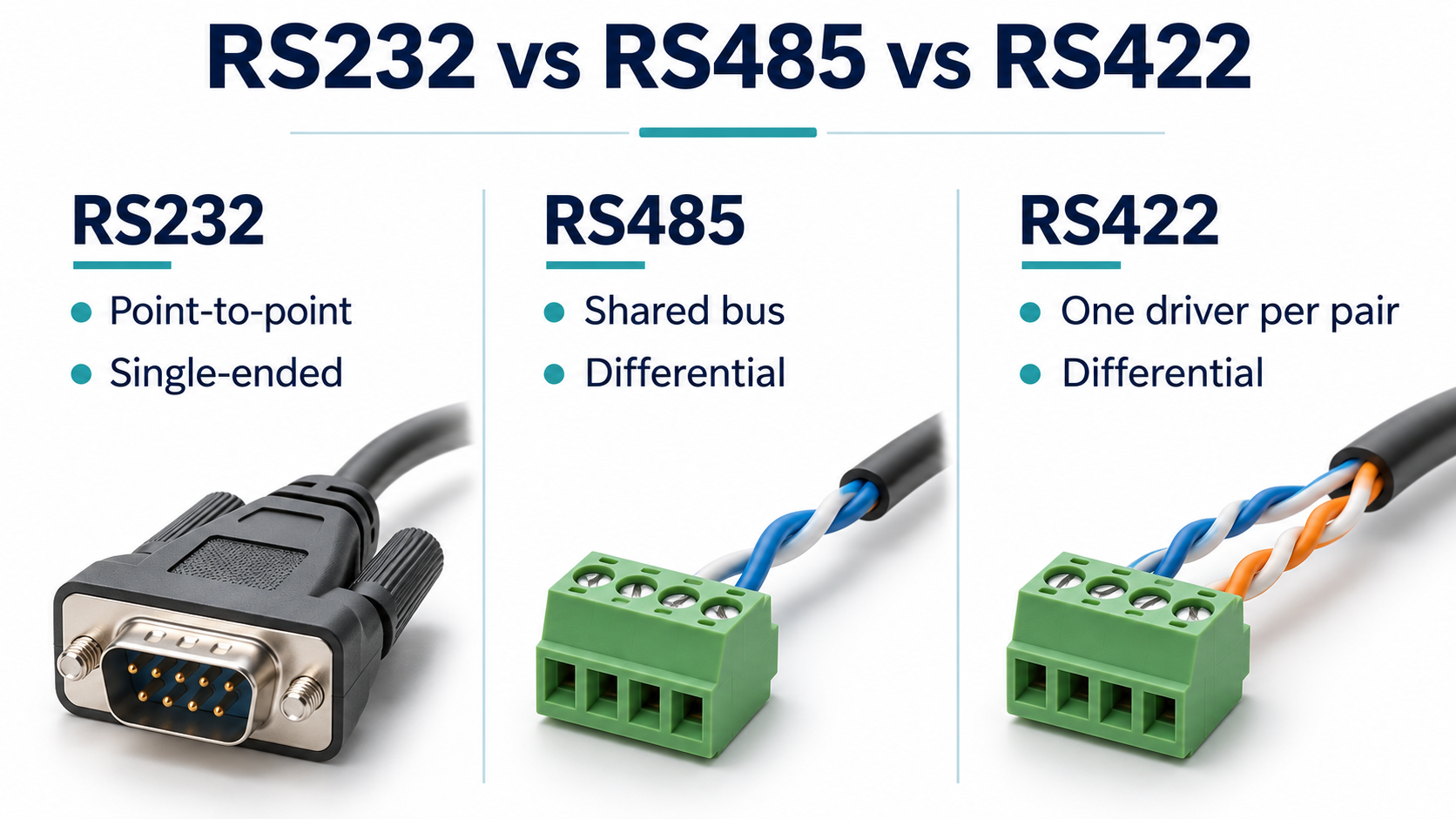
| Feature | RS232 | RS422 | RS485 |
|---|---|---|---|
| Signaling | Single-ended | Differential | Differential |
| Typical arrangement | Point-to-point | One driver with one or more receivers | Multiple transceivers on a bus |
| Common data wiring | TX, RX and signal ground | Separate transmit and receive pairs for full duplex | One data pair for two-wire half duplex |
| Communication mode | Commonly full duplex | Full duplex with separate pairs | Half duplex or full duplex, depending on implementation |
| Typical application | Connecting a PC to a serial instrument | Dedicated differential serial links | PLCs, meters and distributed industrial devices |
| Main selection concern | Pinout and handshake requirements | Transmit/receive pair mapping | Bus layout, direction control and termination |
Cable length and data rate must be considered together. A maximum distance quoted for an interface does not mean that distance is available at every baud rate.
RS232 is commonly found on instruments, legacy machines and equipment with a dedicated serial connection.
A basic link uses transmit, receive and signal ground. Some devices also require hardware flow-control signals, such as RTS and CTS.
Before connecting two RS232 devices, check:
A DB9 connector alone does not confirm that an interface is RS232. Always check the device documentation.
RS422 uses differential signals, which help reject noise picked up along a cable. A full-duplex connection uses one pair for transmission and another pair for reception.
For a two-device link, the transmitter pair on one device connects to the receiver pair on the other. Match positive and negative terminals according to the manuals.
RS422 can suit equipment that needs separate transmit and receive paths. However, it should not be treated as interchangeable with a two-wire RS485 bus.
RS485 is widely used for communication between controllers and distributed industrial devices.
In a typical two-wire network, devices share a differential data pair and take turns transmitting. The communication protocol determines when each device may transmit and how messages are addressed.
RS485 defines electrical behavior. It does not, by itself, define the application protocol.
For example, two devices with RS485 ports may still be unable to communicate if one uses Modbus RTU and the other uses a proprietary protocol.
No. RS232 and RS485 use different electrical signaling. A passive cable that changes the connector shape cannot perform this conversion.
Use an RS232-to-RS485 converter that matches your equipment’s requirements. Check its power method, communication mode, supported baud rates and isolation features.
Similarly, a USB-to-TTL adapter is not a substitute for a USB-to-RS232 adapter.
Start with the interface on each side of the connection:
| Your connection | Product category to consider |
|---|---|
| Computer USB to an RS232 device | USB-to-RS232 adapter |
| Computer USB to a two-wire RS485 network | USB-to-RS485 converter |
| Computer USB to an RS422 device | USB-to-RS422 converter |
| RS232 controller to an RS485 device | RS232-to-RS485 converter |
Then confirm the exact model’s specifications:
• Interface and wiring mode: RS232, RS422 or RS485; two-wire or four-wire.
• Operating system and driver: Match the model and your computer’s OS.
• Signals: Confirm support for any required handshake lines.
• Installation environment: Assess grounding, electrical noise and isolation requirements.
• Connector and pinout: Match electrical signals, not just connector appearance.
DTECH offers serial converter products across these connection categories. Use the individual model documentation to verify compatibility before ordering.
RS485 is often more suitable for shared industrial buses and longer differential links. RS232 remains useful for a simple connection to equipment that already has an RS232 interface.
Not automatically. Their electrical characteristics have similarities, but wiring, transmitter control and network arrangements differ. Check both devices and the converter’s supported modes.
No. RS485 is an electrical interface standard. Modbus is a communication protocol that can operate over different transports.
Yes. An RS485 link can connect a controller to one device. Both endpoints still need compatible settings and protocol support.
Need help choosing a DTECH converter? Share your device models, interface types, cable length, baud rate and operating system so the appropriate model can be identified.
© حقوق النشر: 2026 Guangzhou Dtech Electronics Technology Co.,Ltd. كل الحقوق محفوظة.

